
Two days, from problem to prototype.
From fuzzy problem to testable solution: a 2-day beginner BBC News workshop on discovery, strategy, ideation, prototyping and validation, then a multi-day intermediate programme for the News department, in Miro.
Client
BBC News team
Format
2-day beginner workshop
Also delivered
Multi-day intermediate-level course, News department
Tools used
Miro
From understanding the problem to designing the solution.
The two days were split deliberately: the first spent entirely on understanding the problem, the second on designing and testing a response to it. Both ran from 9:30 to 16:30 with a 45-minute lunch.
Day 1: Understanding the problem
- The importance and definition of UX, and core usability and behavioural principles
- UX maturity, and how to run a heuristic evaluation
- The Kano model and experience mapping
- User research methods
Day 2: Designing the right solution
- Affinity mapping and experience mapping in practice
- Ideation and problem framing
- Rapid prototyping and storyboarding
- Testing and validation methods
Going deeper with the News department.
Alongside the 2-day beginner workshop, we also delivered a separate, multi-day intermediate-level course for the BBC News department — the same overall arc as the workshop, in more depth:
Discovery research
Understanding the problem and the people it affects, before anything gets designed.
UX strategy
UX maturity, heuristic evaluation and the Kano model: frameworks for judging where the team stands and what matters.
Ideation and prototyping
Problem framing, then rapid prototyping and storyboarding to make ideas tangible.
Design validation
Testing and validation methods, so the arc ends on whether an idea actually works.
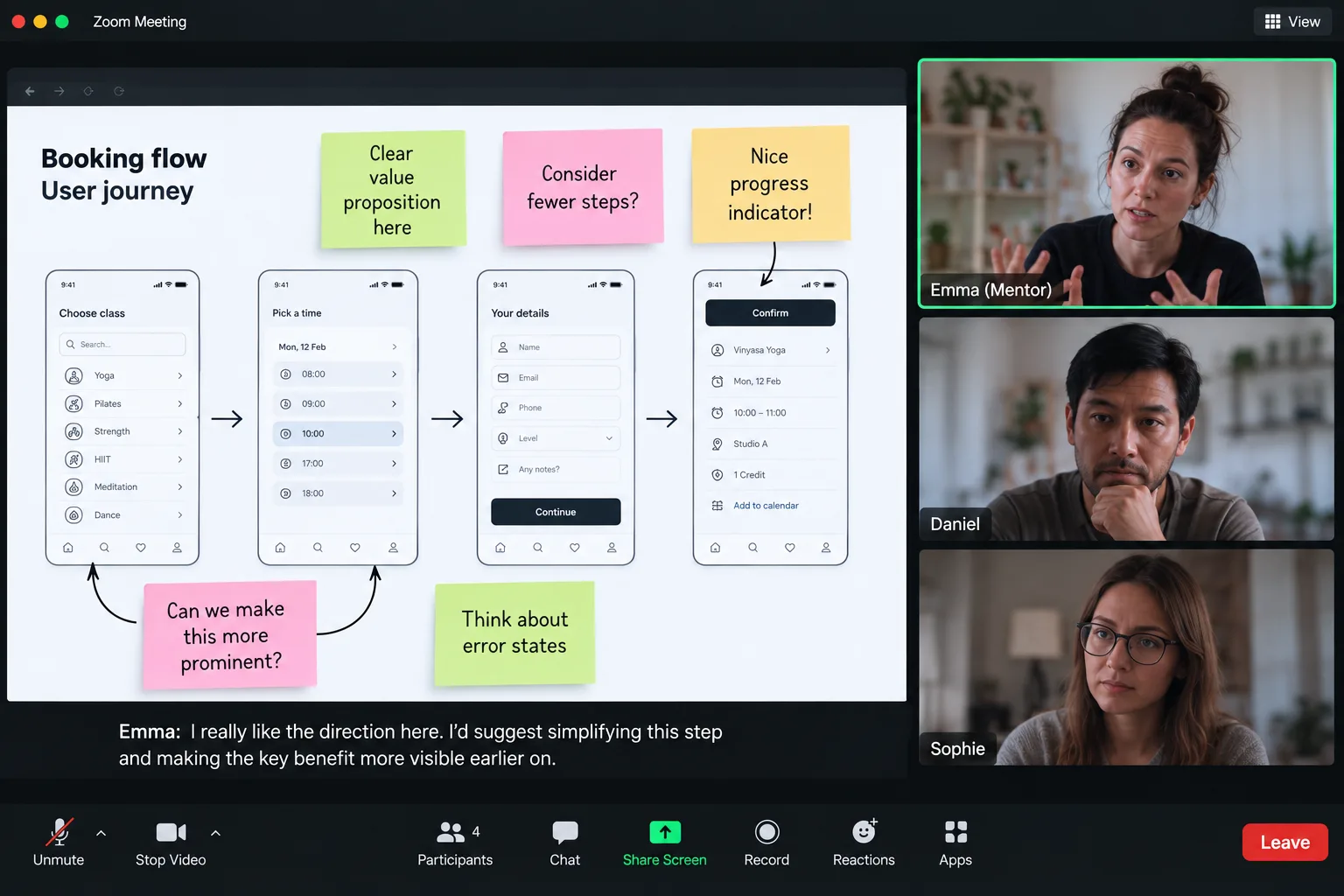
→ live and collaborative, in MiroThe team worked through real exercises together rather than watching a lecture. Today, a team at this level would take our Advanced UX Design course.
Where the BBC sits on the UX maturity curve.
The Nielsen Norman Group (NN/g) describes UX maturity across six stages: Absent, Limited, Emergent, Structured, Integrated, and User-Driven. Organisations move along this curve as design shifts from an afterthought to a discipline embedded across the business.
We’d place the BBC at the Integrated stage of NN/g’s model. That's a reflection of a high level of UX maturity generally: a human-centred approach to its products, a public design system, an established in-house design function, and design research embedded within product teams rather than bolted on at the end. We haven't been given, and don't claim, any internal metrics or outcome data about the BBC’s design practice — this is our external assessment based on what's publicly observable.
What the BBC News team told us.
“The course was very useful and the instructor was very approachable and engaging. It was also really nice to use Miro. It was really great to learn so much about UX and different steps to understand the user’s needs.”
Structure beats a blank page.
Two days isn't long enough to solve a hard problem — but it's long enough to give a team a repeatable process for approaching one. Splitting the workshop cleanly between understanding the problem and designing the solution meant the team left with more than theory: a heuristic evaluation, an experience map, and a tested prototype, built on their own problem, in their own time.
- A short, focused workshop can still cover the full arc from discovery research to a validated prototype.
- Frameworks like the Kano model and heuristic evaluation give teams a shared way to prioritise, not just a shared vocabulary.
- Ending on testing and validation, not ideation, keeps teams honest about whether an idea actually works.
Is your team ready to learn?
Your product, your teams, two days or a longer programme. From £600 per person for onsite, customised multi-day training.