A real brief. A real client. A real presentation back.
The shape of the 10 weeks, told in order: a real client brief on day one, a presentation to the company's decision maker in week 9. A UX course, not a UI course.
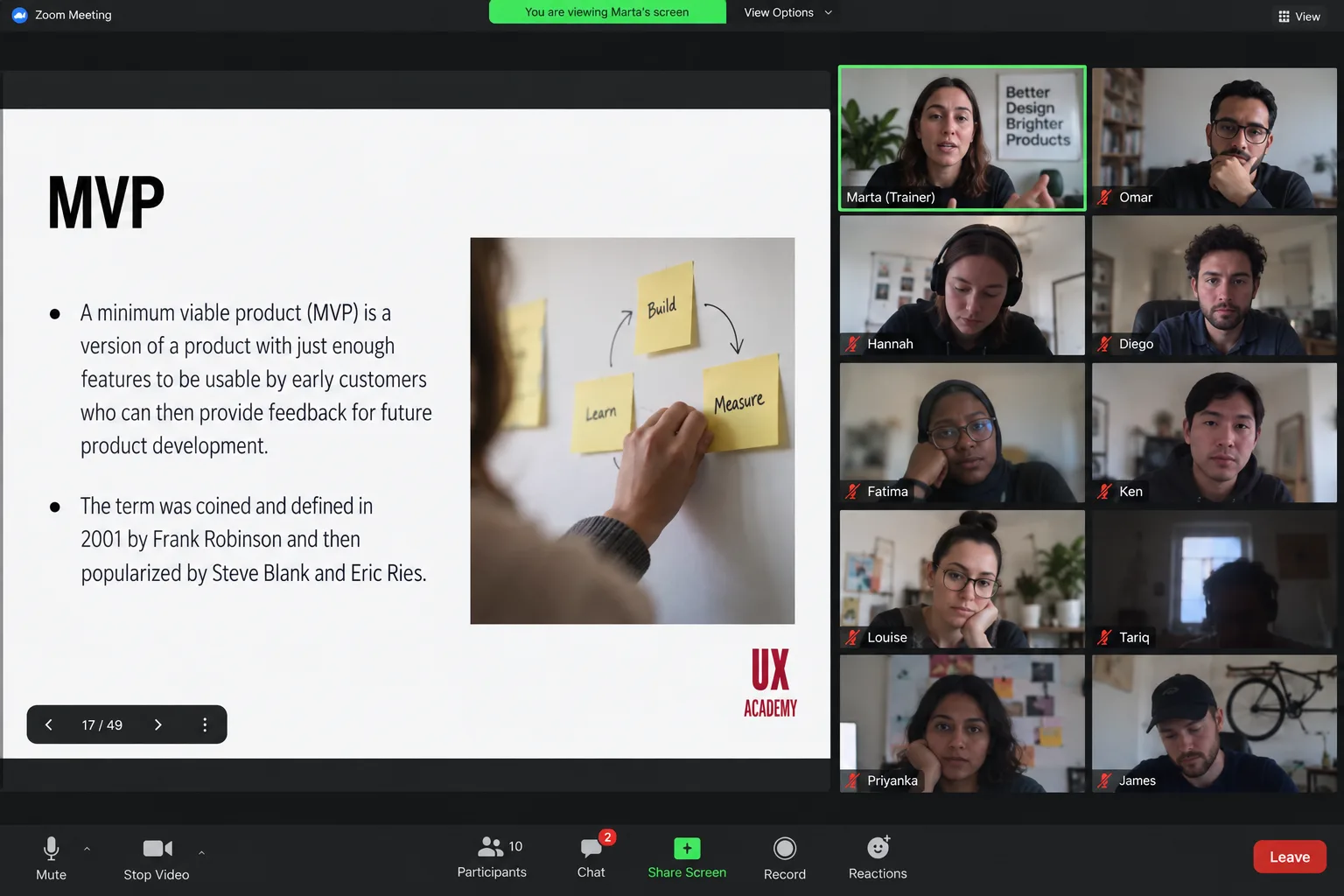
One real client brief per cohort.
Week 1: your team of three gets the brief. Weeks 2 to 8: you research, design and test it. Week 9: you present back to the company's decision maker.
The current cohort's client is a family-organiser app from a two-founder startup.
The ten weeks, in order.
Told as one continuous project, the way it actually runs -- not as a list of modules.
Day one: you get a real brief
Your team receives a real client's brief at the start of the course, not at the end.
→ the client brief, day oneYou work in a small team
A team of three owns the project for the whole course.
→ your team of threeEach week: learn it, then apply it
Each week teaches a stage of the process, applied to your client project the same week.
A weekly 45-minute session with an industry mentor
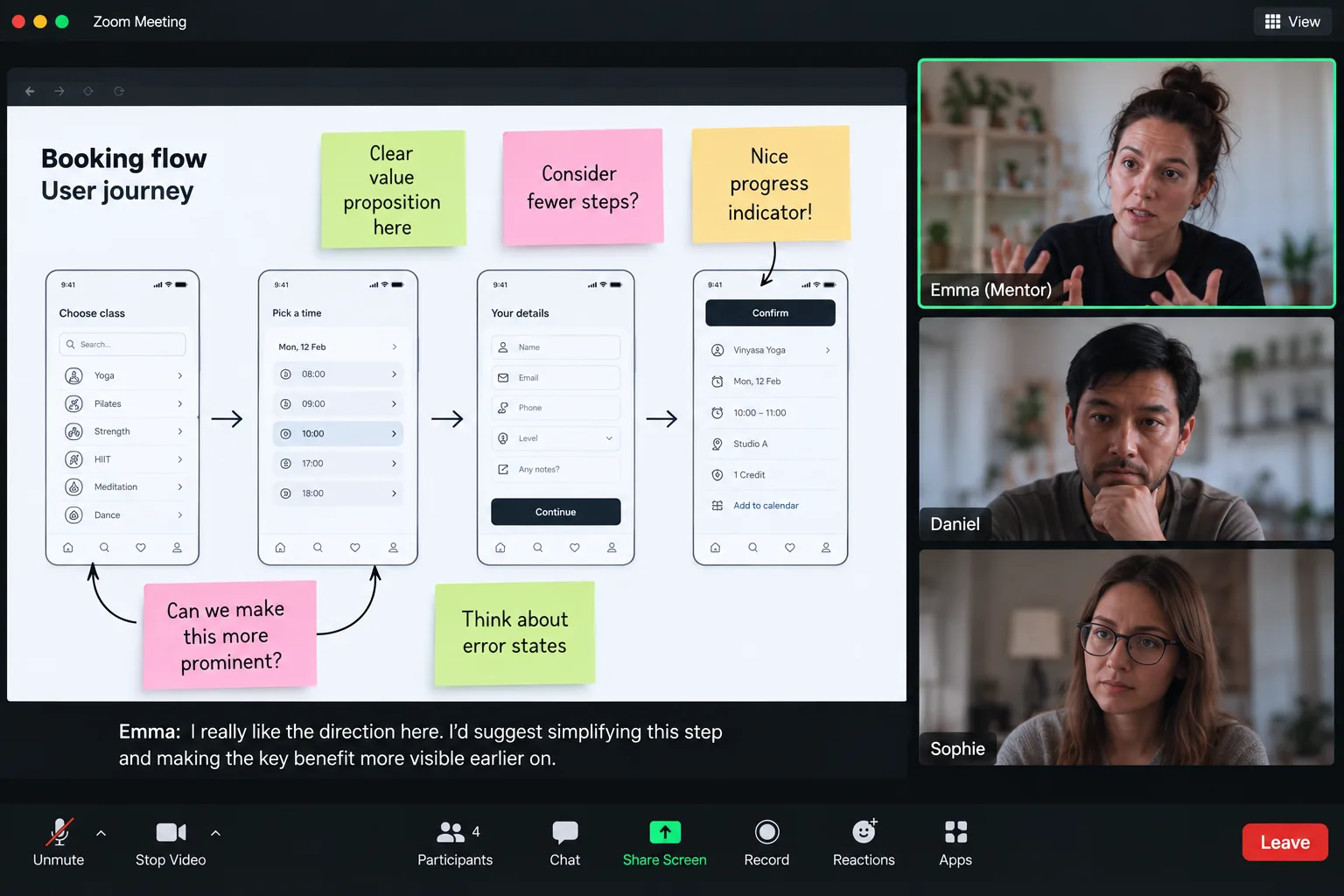
A different mentor each week, arranged separately from class -- a team session, not one-to-one.
→ a 45-minute mentor sessionBetween sessions, the work continues
Your team keeps the project moving during the week: research, reviews, preparing the next mentor session.
You get access to the client
There's an opportunity to put questions to the client during the course.
Your portfolio builds throughout
You finish with a portfolio piece you can show, supported alongside the project work.
Week 9: you present to the client
Your team presents the finished work to the company's decision maker; the presentation and its case study go in your portfolio.
→ the client presentation and your case studyWeek 10: a career support lesson
One lesson on presenting your work and searching for jobs. The UX Career Track goes deeper.
What a session looks like.
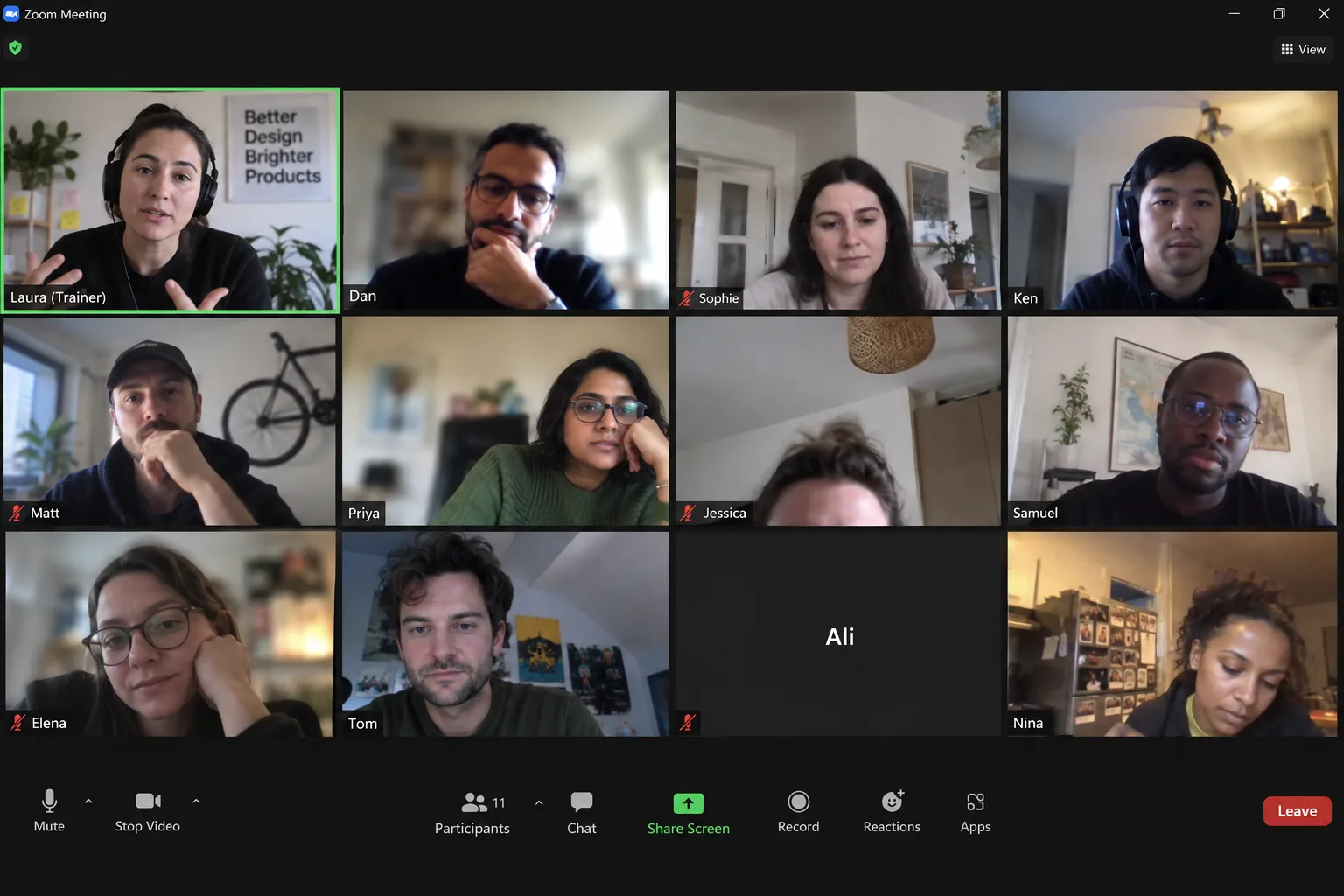
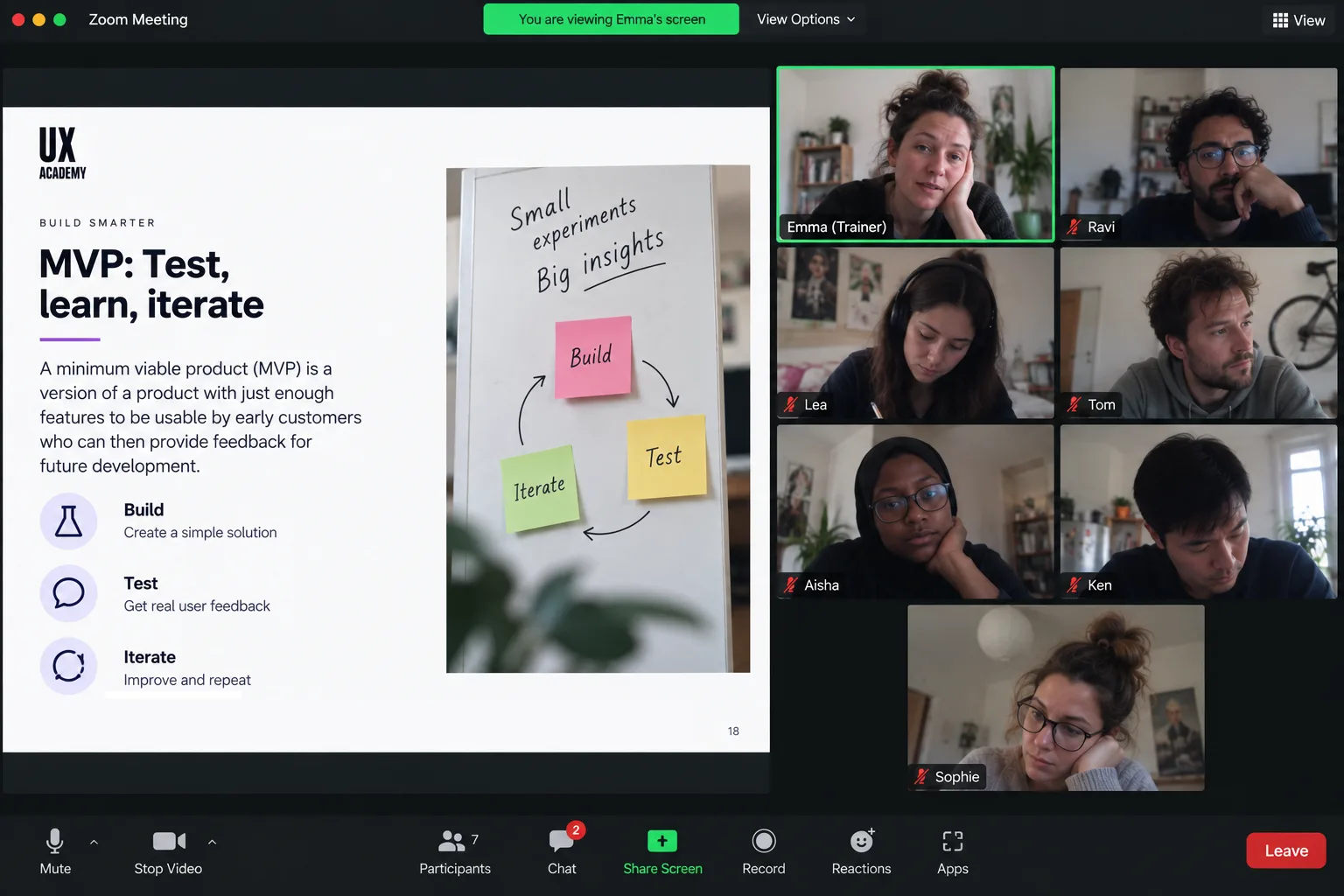
One evening a week, live, with an instructor teaching and your team working the brief. Nothing pre-recorded.
Real companies. Real briefs.
Every cohort works on a brief from a real company, not a simulated exercise. Here is what that looked like for three of the most fully documented projects.
HopStair Limited
A nudge-based mobile app helping people build authentic, lasting confidence through daily prompts, peer support and, in time, a coaching marketplace.
“We would like a final and user tested design that is attractive and sticky, and that starts to maximise user retention within the app.”
Read the full case study →Recruitment & talent marketplaceWelfound
A referral-driven, AI-powered talent marketplace where professionals refer people in their network to highly relevant UK jobs.
“As we are going against the grain of the traditional recruitment process and have such a reliance on the networking effect for this to really work, the UX needs to be intuitive and super simple to drive its usability.”
Read the full case study →PropTech & rentalAvasa
A transparent, end-to-end platform for finding a UK rental home, supported by local rental experts ("Sherpas") and lifestyle-based property search.
“We aren't another real estate agency. Our objective is to find properties that match the needs of the tenants and be on their side if they need help at every step of the rental process.”
Read the full case study →Other real client briefs our cohorts have worked on include Mayfair Aesthetics, Loop Not Luck, Oh Lily!, Academator, ClickedDating, Blindlee, Charrli and EXabler (Parkway Logic Ltd). See every project at Student Work.
Not every brief makes the cut.
A real client project only works if it's a project your team can actually complete and actually publish. So before we bring a company on, we check it against a short set of criteria.
We validate every brief
Not every brief that comes to us gets used.
An existing product
We don't build from a blank page -- most companies we work with are early-stage.
Publishing rights, agreed upfront
The company agrees your team can publish the work as a portfolio case study.
Real users for testing
The business normally provides the users, so you test with people who'd actually use it.
Recruitable users
We turn down briefs needing users a student team couldn't realistically reach.
Questions, answered.
If the project is a team project, do I still get my own portfolio piece?
Yes. Your team of three shares the brief and divides up the research, but each person does their own design work and writes their own case study: what you decided, what you tested, what you'd do differently. The brief is shared and the portfolio piece is yours. It ends with something a course exercise can't give you -- your team presents the work back to the real client, and their reaction goes into the case study.
Is the work peer reviewed?
Yes, in two ways. Your project team reviews the work between sessions as the project moves, and the cohort shares work for review on Fridays. On top of that your team has a 45-minute session with an industry mentor each week, a different mentor every time. It's with the whole team rather than one-to-one, which matters if a dedicated personal mentor is what you're looking for.
Is this a UX course or a UI design course?
It's a UX course. You learn research, journeys, structure, prototyping and testing. You wireframe and prototype in Figma, but it isn't a UI or visual design course.
Who actually tests the prototypes you build in the course?
It depends on the brief. For usability testing you generally don't need more than five people to get a clear read -- it's rare to get a split like two-two-one, so five people nearly always gives you a clear majority view, which our lead instructor Natalia Veretenyk teaches as a rule of thumb. In a real business, teams often test with tools such as usertesting.com, where you set a target persona and get feedback on your interface from people who match it. For a B2B brief specifically, the testers are usually people who are realistic to find -- a product manager or another designer, for example -- rather than a specialist role that would be too hard to recruit. That's also one of the reasons we turn down a brief if its real users would be too hard for a student team to reach.
Can my employer pay for the course?
Yes. Send us your company's billing details, plus a PO number if your company uses one, and we'll invoice them directly. There's no deposit when an employer is paying. Book a call at myuxacademy.com/book-a-call/ or email hello@myuxacademy.com and we'll sort it.
How long is the course, and how is it scheduled?
10 weeks, one live session a week -- evenings, 6:00 to 8:30pm uk time. Every session is live. Nothing is pre-recorded, though sessions are recorded so you can catch up if you miss one.
How much time does it take each week?
Around 5 to 6 hours a week in total, including the independent project work you do between sessions.
How big is my project team, and how much mentor support do I get?
A team of three people, working on one client brief together for the whole course. Your team gets a 45-minute session with an industry mentor each week, a different one every time -- a team session, not one-to-one mentorship.
Do I need any prior design experience?
No prior design experience is required. If you have already done some free or self-paced UX learning, that helps -- the course is intensive and practical, and people who arrive already comfortable with the basics tend to get more out of it.
How many people are in a cohort?
Cohorts are capped at 10 people, and most run smaller than that.
Do I get a certificate or an accredited qualification?
You receive a certificate confirming you completed the course. It's a certificate of completion, not an accredited qualification.
Do I get any discounts on design tools while studying?
UX Academy has partnerships with design software companies, so students get free access to some tools while studying -- not every tool, but a genuine saving on the ones we can secure.
How do you choose which companies bring a live brief?
We validate the project itself before we take the company on -- not every brief that comes to us gets used. The company needs an existing prototype or working product; we don't build projects from a blank page, and most of the companies we work with are early-stage. They have to agree upfront that your team can publish the work as a portfolio case study, and they normally provide the users for testing. We turn down briefs whose users would be too hard for a student team to recruit -- a brief that needs a nuclear scientist or a senior accountant isn't one we take on.
Talk it through with a real person.
The fastest way to know whether this is the right move for you is a short call, not another page of copy.
Would rather just talk? Speak to an advisor — fifteen minutes, no pitch.