
We trained developers, not designers.
Starlizard, a sports-betting analytics and trading firm, needed its development team to think like designers: building intuitive interfaces for vast data, without overwhelming internal users or breaking legacy systems.
Client
Starlizard
Team trained
Development team
Format
Beginner UX programme, 2 groups
Session length
2.5 hours, twice weekly
Duration
8 weeks
Delivered
Jan - Mar 2021
Moving fast comes with a cost.
The situation
Starlizard moves fast and constantly looks for ways to improve. To keep pace with that drive, UI screens were often the last aspect in the priority order. This had led to either functionality not appearing on optimal screens, or a series of disparate screens that users (all internal to the company) needed to access daily.
Two core problems
- Displaying vast amounts of data: How to present key information in a consumable view without overwhelming users.
- Legacy systems in production: The familiar systems had been in use for years. Any usability improvements had to happen while being conscious that stark visual or interaction changes would negatively impact daily users.
The goal
Design newer screens that improve the user experience, present key data clearly and precisely, and create a path to retire legacy systems once users had confidence in the new approach.
Teaching developers to think like designers.
Rather than parachuting designers in to solve the problem, Starlizard invested in their own team. We ran the Beginner UX programme for two separate groups of their developers over eight weeks, running from late January through mid-March 2021.
The eight-week structure
- Two parallel cohorts: Group 1 and Group 2 each met twice per week for 2.5-hour sessions, allowing the programme to scale without losing the interactive, workshop-based format.
- Four mentoring hours: One-hour drop-in sessions interspersed throughout the eight weeks, giving participants space to work on their real project and ask questions as they applied what they were learning.
- UX Strategy sessions: A third group participated in two separate UX Strategy sessions in March, providing additional strategic depth for those who needed it.
What the programme covered
The Beginner UX curriculum walks teams through the complete design process: user research and insights, hypothesis-driven design, prototyping, and user testing. All learning was applied directly to Starlizard’s actual project — their participants weren’t solving hypothetical problems, but working on real screens and real data challenges.
A complete design process in action.
The brief set these as the minimum deliverables for the programme — the artefacts participants worked towards across the eight weeks.
Eight weeks — twice-weekly 2.5-hour sessions — four mentoring hours
Hypothesis statements
Clear, testable hypotheses about what users needed and how changes would improve the experience.
→ the hypothesis statementsUser insights report
Findings from discovery research with users, synthesised into themes and patterns.
→ the insights reportPrototypes
Working prototypes of proposed solutions, tested with users to validate the direction.
→ tested prototypesUser flows
Documented flows showing how users would move through the new screens and what they'd see at each step.
→ user flowsDesign presentations
Discovery research insights, the problem and hypotheses, the design process walkthrough, evidence of iteration based on feedback, and a prototype demo.
→ the design presentationNext steps roadmap
Clear recommendations for how to move forward, which problems to tackle next, and how to de-risk the rollout to legacy-system users.
→ the roadmap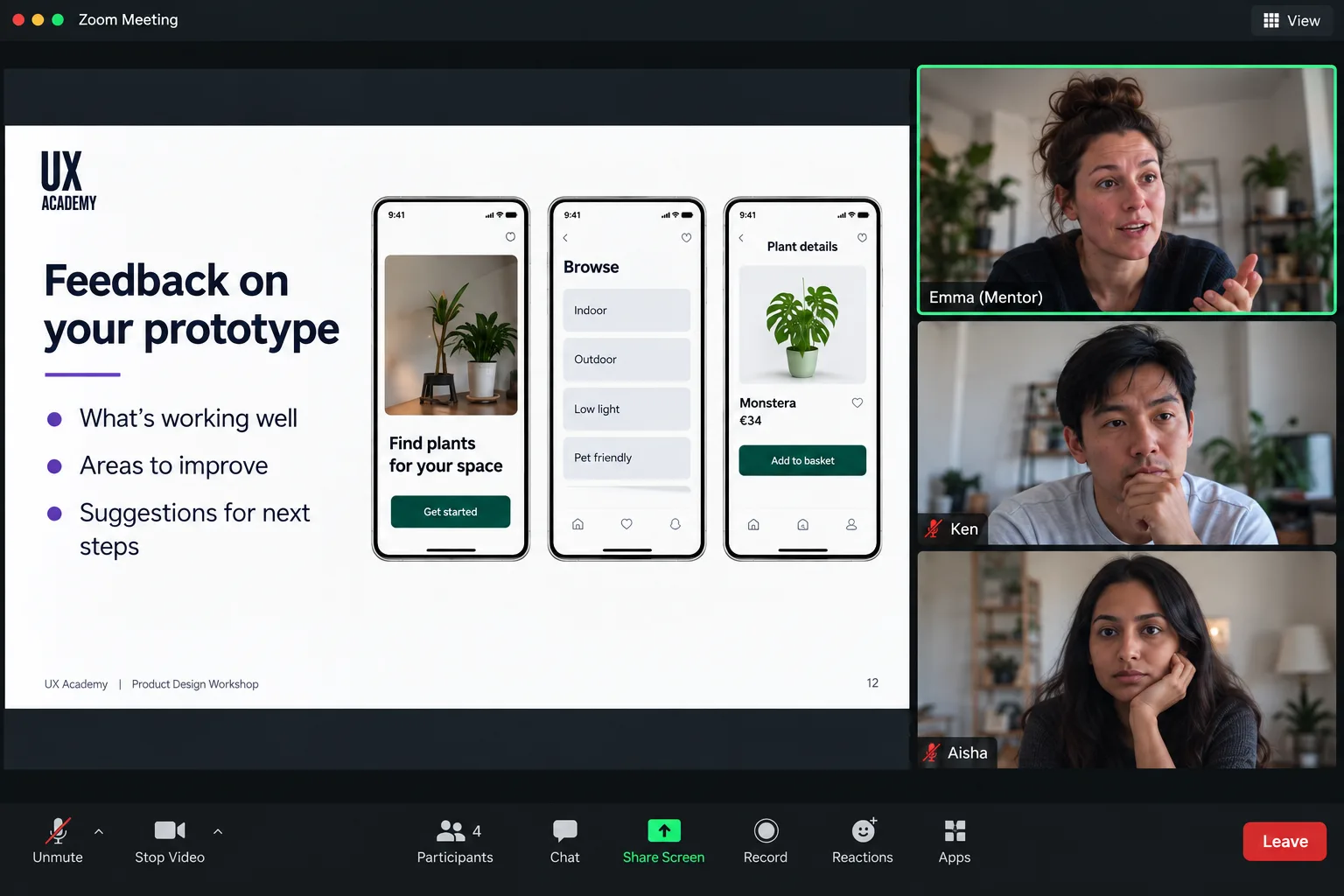
Development teams can design well.
The assumption that only design specialists can solve design problems is wrong. Engineers, product managers, and operations teams who spend every day alongside users often have the deepest insight into what users actually need. The missing piece is usually not talent or instinct — it’s a shared vocabulary and a process to test assumptions before building.
- Developers who can run research stop building features in a vacuum.
- A shared design process lets teams critique each other’s work and decide together -- no external expert required.
Is your team ready to learn?
Engineering-led team? This is the playbook. From £600 per person for onsite, customised multi-day training.