Trading Skills
by Tim Penton · Community & marketplace
An app for trading skills with your local community: help someone for an hour, and get an hour of help back.
A course project, not a client brief
The opening slide reads "8 weeks beginner course blog by Tim Penton" and links to the blog the student kept through the course. There's no client and no commissioned brief.
UX Academy cohorts also work on real client briefs for named companies, and those are published separately. This page is the other kind of portfolio piece: one a student chose, scoped and ran on their own.
What they chose to work on.
Trading Skills is a time-bank in an app. The hours you spend helping someone come back to you as hours of help from someone else -- baking a cake can be exchanged for childcare, or for a hand with the DIY. A step-by-step flow produces an advert saying what you need, where, on what date and for how many hours.
The problem it's aimed at came out of the interviews: people have skills they're happy to use for family and friends, don't know their neighbours well, and don't trust local tradespeople they haven't been recommended to.
How they researched it, and what came back.
Interviews were structured around the work people actually need doing: housework and chores, how they locate a tradesperson or someone with the right skill or simply the muscle for a job, what skills the interviewee has themselves, their comfort with technology, their local area, and whether an app like this would help at all.
Two personas came out of it, Adila, 31, and Jeff, 40. Both sit in the 30 to 40 range, neither knows anyone locally beyond family and friends, both have skills they use to help family members, and both find local traders hard to find and hard to trust because they only really trust recommendations from family and friends. Both are constantly looking for people with the skills they need.
The team also worked with two situational personas -- a first-time buyer (a young couple in their late twenties to early thirties who have just moved into their first home, tech-confident but not keen on DIY) and a part-time working mother of three -- to keep the design honest about how little spare time either group has.
Methods used
What they designed.
Ideation ran wide before it ran narrow: journey maps, mind maps, random links and creative stimulus, deliberately considering other environments related to the users. The student singles out journey mapping as the technique that worked hardest, because taking a persona and mapping out their day is what shows you where the product would actually be useful.
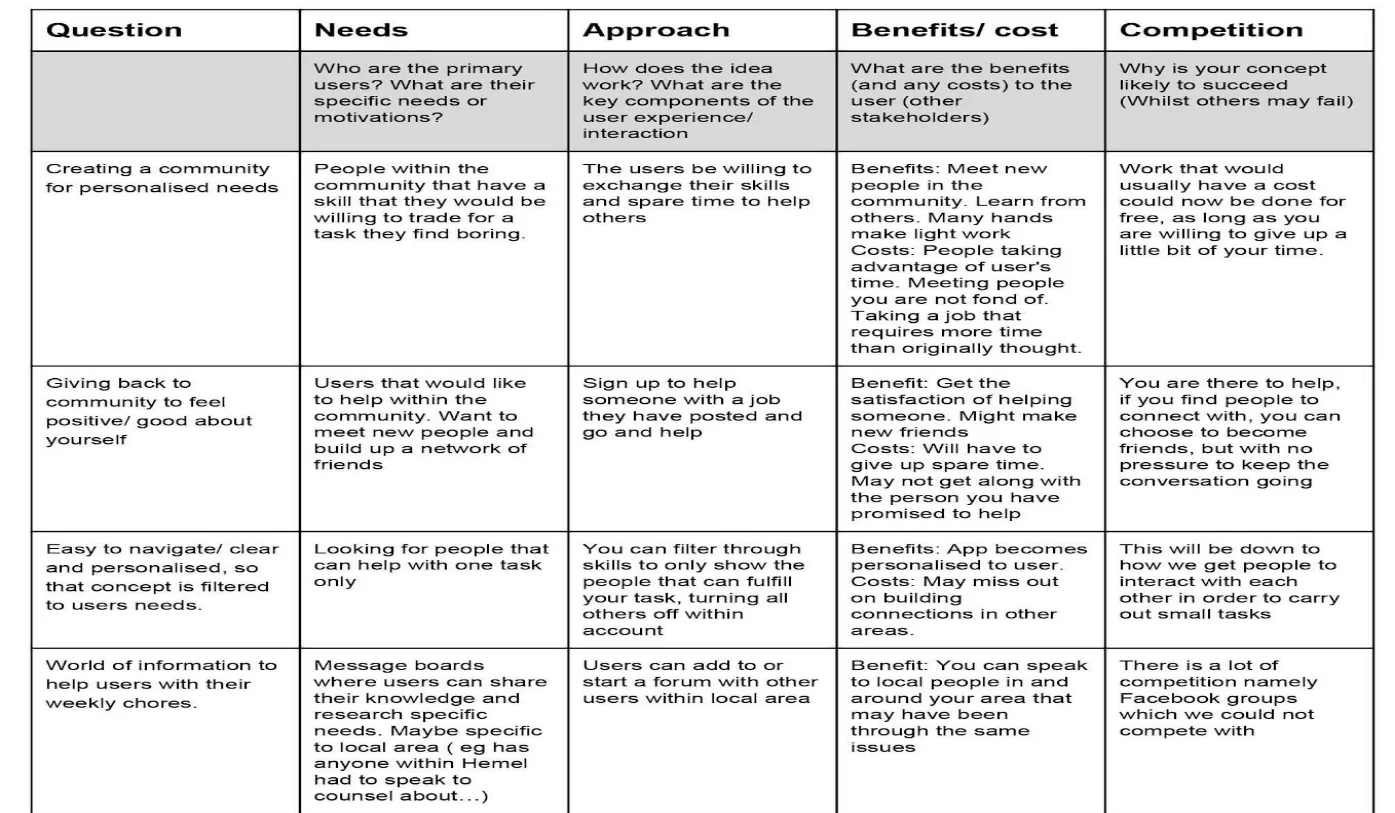
Four ideas were then written up in full using NABC -- Needs, Approach, Benefits and cost, Competition -- which forced each idea to state who it's for, how it works, what it costs the user as well as what it gives them, and why it would survive against what already exists. The benefits column includes the costs honestly: people taking advantage of a user's time, meeting people you aren't fond of, taking on a job that turns out to need more time than you thought.
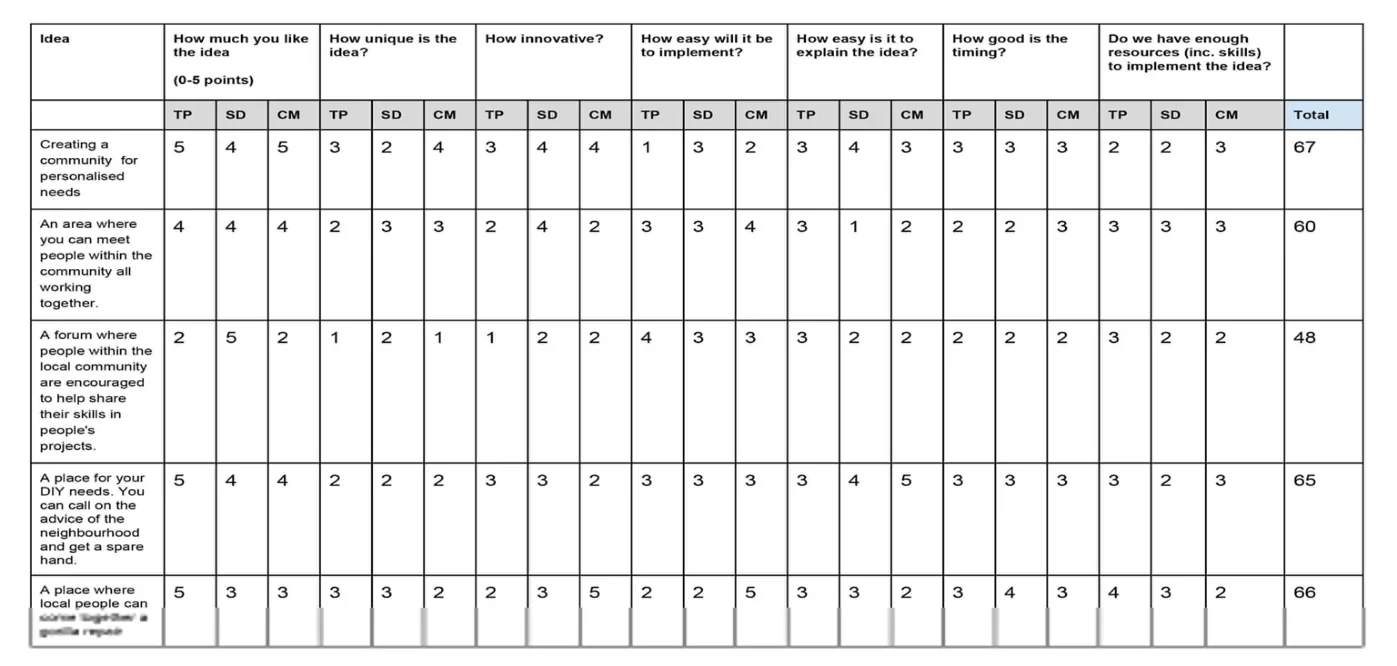
The ideas were then scored. Three people rated five concepts across eight criteria -- how much you like the idea, how unique it's, how innovative, how easy to implement, how easy to explain, the timing, and whether the team had the resources and skills to build it. "Creating a community for personalised needs" won on 67 points, ahead of 66, 65, 60 and 48. The decision is on the page with the numbers behind it, which is the point of scoring rather than arguing.
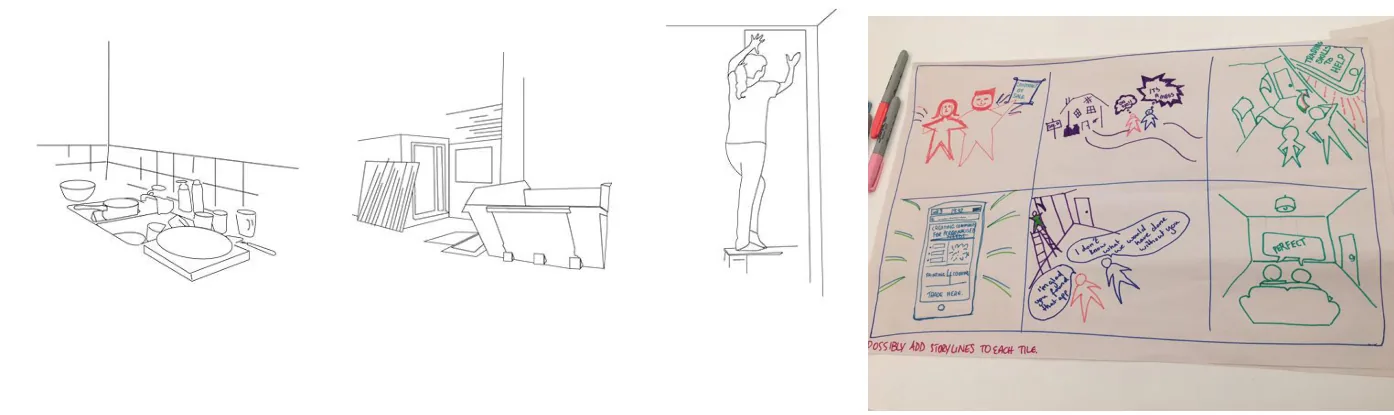
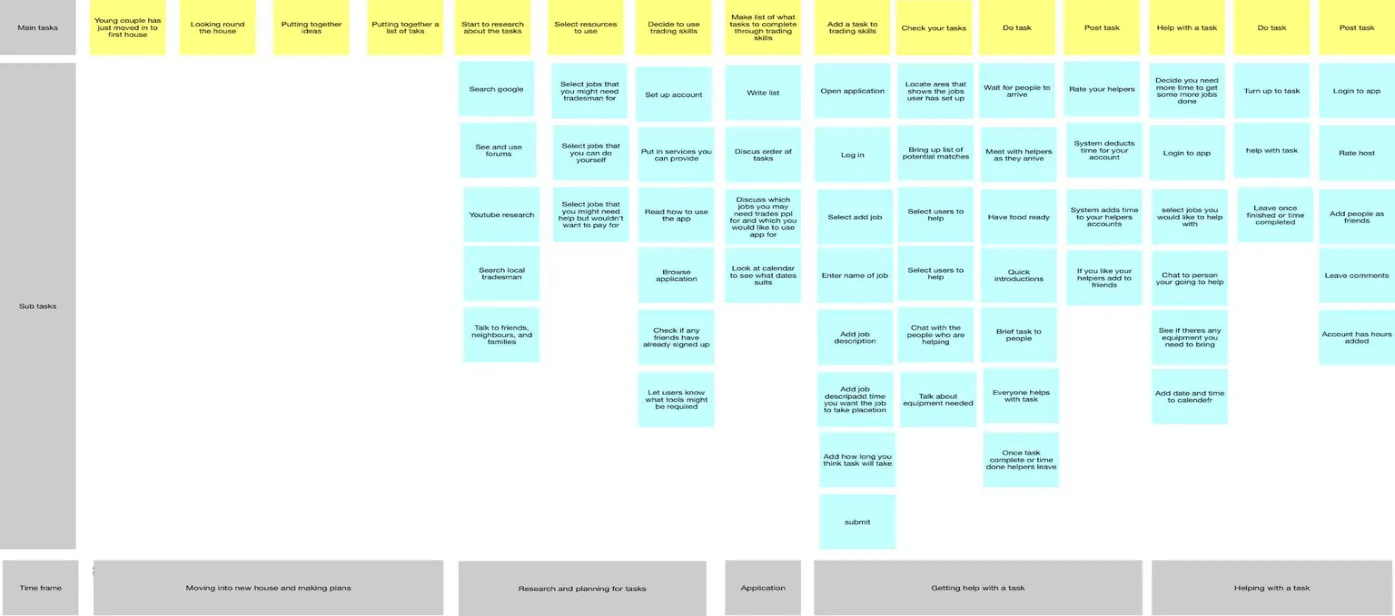
A storyboard set out the chosen concept: reach out to the local community for help with a task, pay in time, and earn more time by helping other people. An information-architecture journey map then ran the persona through every task in a DIY job, from moving into the house and making plans, through research and planning, to the application itself, getting help with a task, and helping with someone else's.
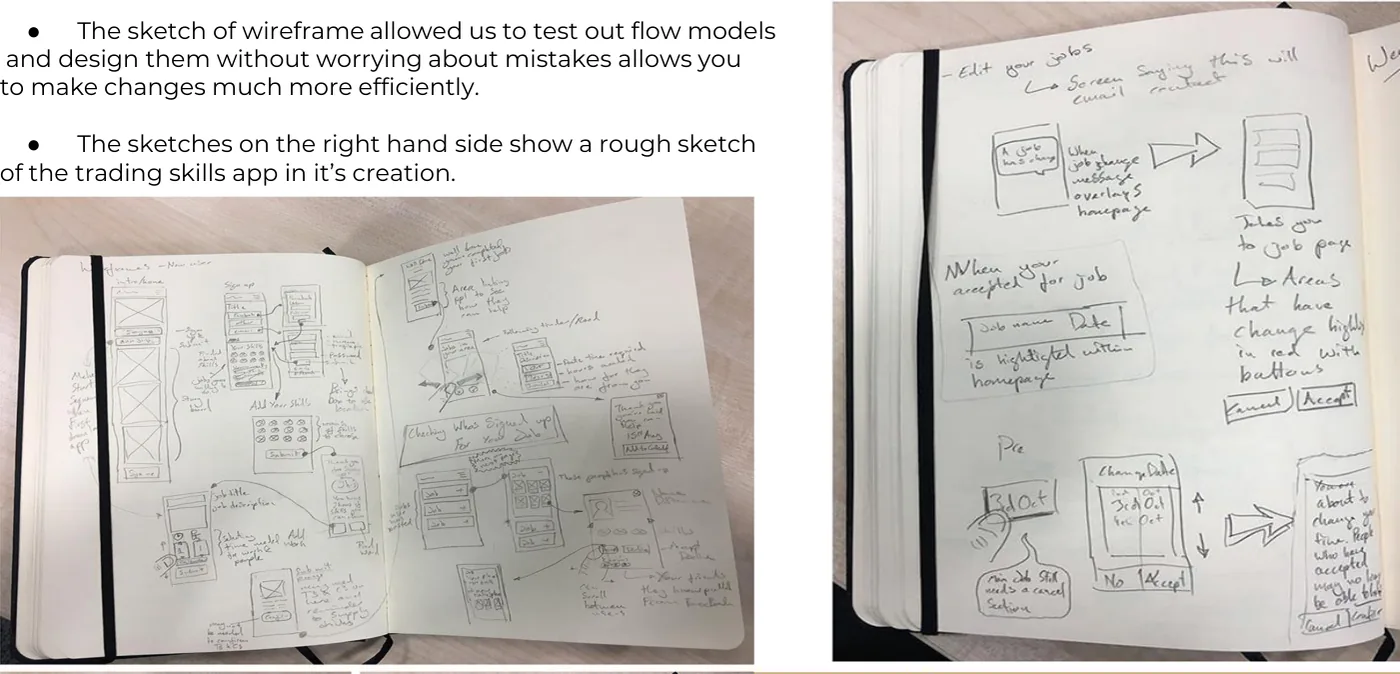
User flows were drawn for two states -- a new user setting up, joining and choosing jobs, and an existing user reviewing their jobs, checking who has offered to help, and editing their profile. Wireframes were sketched in a notebook, then built into a testable prototype in Proto.io covering signup, setting up a job with the skills and hours required, choosing helpers from the people who offered, confirming the job, and the conversation that follows.
Built in: Proto.io
The actual work.
Artefacts from the project deck by Tim Penton — the research boards, the sketches and the screens, as they were made.
What they learned.
Taken from the end of the deck, including the parts most people leave out. A portfolio project that reports what failed is worth more in an interview than one that only reports what shipped.
On sketching: "The sketch of wireframe allowed us to test out flow models and design them without worrying about mistakes allows you to make changes much more efficiently." The value named is speed of change, not fidelity.
The prototype was first walked through by the student himself, with a user journey written out to show how a user would flow through the app, and notes and alterations taken from the rest of the class. The deck records the iteration but no formal usability-test findings and no outcome, so none is claimed here.
Who did the work.
Named exactly as the project deck names them. Where the deck gives first names only, first names only are published.
Two kinds of portfolio piece.
UX Academy courses are 100% live online and capped at 10 students. Cohorts work on a genuine client brief and present it back to the client — and students also run their own self-directed projects like this one, where they pick the problem, choose the methods and defend the decisions themselves. Both end up in a portfolio; they aren't the same thing, and this site doesn't present them as though they were.
Courses that cover this kind of work.
Want a project like this in your portfolio?
Get the full curriculum and see how the projects run.
Start from nothing. Finish with a portfolio.
Speak to an advisor about whether this is a realistic move for you, or browse the courses to find your fit.